A Rotation Back to Fundamentals: A Tailwind for Sustainable Investing?
The Portfolio Managers of the Hennessy Sustainable ETF discuss the equity market over 2025, how transportation holdings fit into the portfolio’s investment approach, sector weighting changes over 2025, and their outlook.
-
 Bill DavisPortfolio Manager
 -
 Kyle BalkissoonPortfolio Manager
Key Takeaways
» In 2025, the equity market was driven primarily by mega-cap technology companies.
» The ETF does not exclude transportation stocks. Instead, we focus on companies that meet our sustainability-related KPIs in essential sectors like airlines and autos.
» Our sector weightings change each quarter as we seek to minimize tail risk, though overall allocations typically remain relatively stable.
» In most market environments, the companies in the bottom two-thirds of the S&P 500, from a capitalization weight perspective, have outperformed the top one-third.
» In 2026, AI-focused companies may disappoint: high costs, incremental gains, and valuation risk could drive a rotation to efficient, cash-flow businesses.
Would you please provide your perspective on the equity market over 2025?
In 2025, equity market gains were largely concentrated in mega-cap technology companies, creating a rally that favored the largest names and those with exposure to artificial intelligence (AI) themes. Our quantitative model for the Hennessy Sustainable ETF demonstrated solid stock selection. However, relative performance was primarily influenced by our more diversified positioning, specifically, a lower allocation to mega-cap stocks than the S&P 500® Index, which tempered results during this narrow, top-heavy market environment.
Would you please discuss how the ETF’s transportation holdings fit into your sustainable investment approach?
Our sustainable investment approach does not exclude transportation sectors including airlines, autos, and cruise operators. These sectors are essential to the economy. Therefore, we focus on owning the companies that successfully manage sustainability-related key performance indicators such as energy productivity, safety performance, and leadership diversity. We combine this sustainability lens with rigorous financial analysis because we believe companies that are operationally stronger and better managed on material sustainability risks could be positioned to outperform, including on a risk-adjusted basis, over time.
As of the beginning of 2026, the transportation holdings that scored well on sustainability metircs and that we believe have the potential to outperform based on our models include Carnival Corp., Ford Motor Co. and General Motors Co.
How has the ETF’s sector weightings changed over the past year?
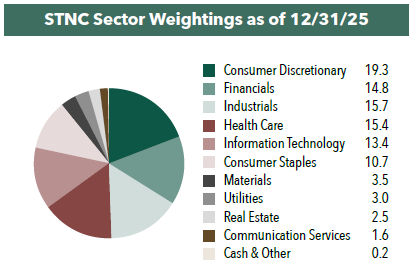
Our sector weightings change each quarter as we seek to minimize tail risk, though overall allocations typically remain relatively stable. As year-end 2025, the largest sector weightings were Consumer Discretionary and Financials—the same as at the start of 2025, though the combined weighting in these sectors was lower by year-end.
The Fund also increased its weighting to Industrials and Information Technology over the course of the year. As of the end of 2025, the Fund held 15.7% and 13.4% in Industrials and Tech, respectively, up from less than 12% and 10%, respectively, at the beginning of the year.
Why does the model tend to favor mid-cap companies over their large-cap peers?
Historically, in most market environments, the companies in the bottom two-thirds of the S&P 500, from a capitalization weight perspective, have outperformed the top one-third. For example, in a comparison of the performance of the S&P 500® Equal Weight Index to the market-cap-weighted S&P 500 over the past 30 years, the Equal Weight Index generally outperformed, and especially so after prolonged dominance of market cap weighting.
Specifically, prior to the period between January of 2023 and June of 2024, for 20 straight years, the S&P 500 Equal Weight outperformed the overall S&P 500 (which is market-cap-weighted) by 300 basis points on an annualized basis.
What is your outlook for 2026?
In 2026, we expect AI may fall short of the market’s financial expectations. Adoption is advancing, but the total cost of ownership, which includes computing power and energy requirements, integration, data readiness, and governance, remains high, and many use cases still lack clear, scalable return on investment. As investors shift from capital expenditure narratives to measurable monetization, richly valued AI leaders may be vulnerable to a valuation reset.
We also believe progress in large language models is becoming more incremental, with many improvements representing marginal refinements rather than a significant change in underlying “intelligence.” This backdrop could support a rotation toward more fundamental areas of the economy: businesses with durable demand, visible cash flows, and improving productivity, where sustainability is expressed through efficiency, resilience, and lower resource intensity.
- In this article:
- Sustainable ETF
